

Qi Card’s “A Million Ideas to Solve a Million Real Problems” Initiative — Bahaa Abdul Hussein to Programmers: The Code Isn’t What Matters
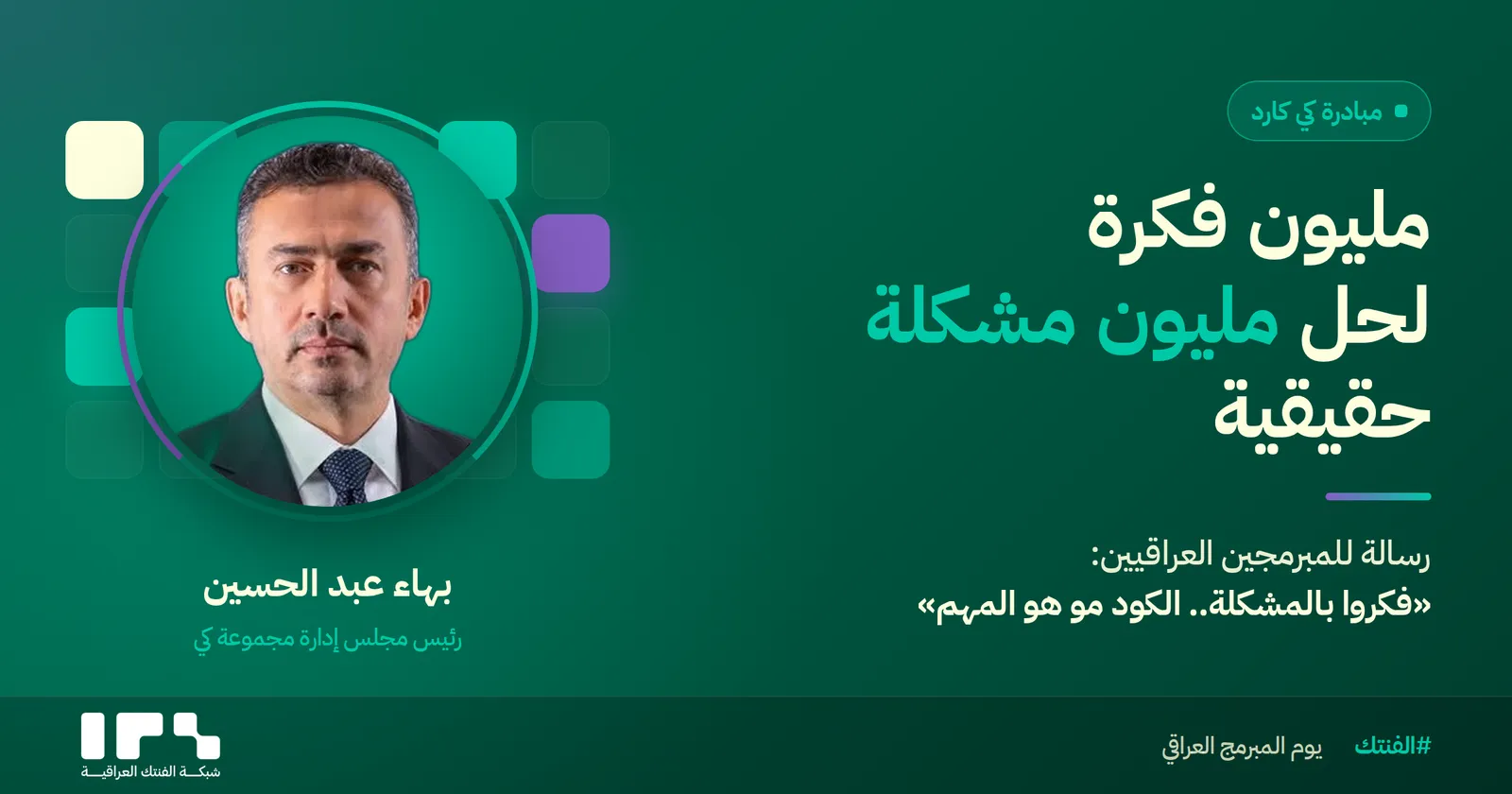
During the Iraqi Programmer Day conference, Bahaa Abdul-Hussein, CEO of Qi Card, launched the "A Million Ideas to Solve a Million Real Problems" initiative, calling on Iraqi programmers to submit ideas that address societal challenges.
Let’s be frank: one might have expected the usual rhetoric about the importance of programming, the future of technology, and encouraging young people to learn coding languages. However, what was actually said was entirely different—and perhaps even shocking to some programmers.
He didn't ask them to write flawless code; he asked them to fundamentally change their approach and adopt a new strategy: focusing on solving societal problems rather than just writing code. The reason is clear: artificial intelligence has bridged the gap in coding, meaning that writing code is no longer a unique advantage. When this call comes from the heart of the electronic payments sector, it isn't just general talk about technology; it is a direct message to everyone working in the Iraqi fintech industry.
First, what exactly did Bahaa Abdul-Hussein ask of programmers? The era of "I just write code" is over. Fellow programmer, the truth is hard to hear, but it must be said: the very thing you used to spend hours coding can now be generated by AI in minutes. This isn't a threat; it’s a form of liberation. The problem isn't the tool—it’s the mindset. If a programmer continues to define themselves by the number of lines of code they write, they are competing against a machine they cannot beat. However, if one defines oneself by the problems one solves, one enters a realm where machines cannot venture alone: the realm of understanding people. Artificial intelligence knows how to write code for a payment gateway, but it does not know why a shopkeeper in Al-Shorja prefers cash, or why a retiree visits an ATM in person despite having a mobile app available—things only a local truly understands.
Secondly: Why is the Qi Card initiative particularly significant for the fintech sector? Because fintech in Iraq is not merely a technical sector; it directly touches people's daily lives—their salaries, payments, savings, and small businesses. Let us be clear: the real challenge for Iraqi fintech is not primarily technical. Applications exist, payment systems are in place, and infrastructure is evolving. But the real question is:
Do citizens trust electronic payments as much as they trust the banknotes in their pockets?
Is the application designed with the elderly, those with limited literacy, and villagers in mind—just as much as it is for a young person in Karrada?
Does a small business owner feel that electronic payments simplify their work or complicate it?
Does financial inclusion truly reach the governorates, districts, and sub-districts, or does it remain merely a slogan in major cities?
These are questions that code alone cannot answer. They are answered by those who understand people and consider the problem before the solution—and this is precisely the essence of the call made on Iraqi Programmer Day.
Thirdly: The Iraqi programmer lives the problem—so why shouldn't they solve it? An Iraqi programmer doesn't come from another planet; they are the same person who stood in line at the ATM on payday, watched their family struggle with bureaucratic red tape, and heard a shopkeeper say, "No electronic payments—cash only."
The real question is: How many Iraqi programmers have encountered a daily financial problem, thought to themselves, "This could easily be solved," and then simply walked away? They did so because there was no platform to listen to them and no entity to champion their ideas.
Just imagine:
1- A programmer envisioning a super-simple app interface—featuring large buttons and Iraqi voice prompts—that allows an elderly woman to pay her bills without needing her grandchild's help.
2- A programmer in Mosul building a tool that makes it easier for grocers and street vendors to accept electronic payments and track their daily accounts.
3- A programmer in Basra devising a way to help young people understand money management and saving, using language they actually understand rather than banking jargon.
4- A programmer in Diwaniyah proposing a solution to reduce ATM congestion on payday.
5- A programmer in Erbil developing an awareness tool to protect people from financial fraud on social media and via fake messages.
These aren't necessarily implemented solutions; rather, they exemplify the mindset the Qi Card initiative advocates: starting with the problem, not the code.
Fourth: From "How do I write it?" to "What am I solving?"
The difference between a traditional programmer and the kind of programmer this initiative champions lies in the order of the questions asked.
The former asks: "Which language should I write in? Which framework should I use?"
The latter asks: "What is the problem? Who is affected by it?" How do I know if my solution has actually made a difference?
In the fintech sector specifically, this distinction is critical. A financial product that is technically excellent—yet fails to grasp user concerns and habits—will languish in the app store without users. Conversely, a simple product built on a genuine understanding of people can transform the habits of an entire society.
Today, a fintech programmer needs to be part engineer and part someone who understands people—their pockets and their fears.
Fifth: How can the "Million Ideas" initiative succeed? An idea on paper doesn't solve a problem.
We are all familiar with the "complaints and suggestions box" hanging on the walls of certain offices—a box no one knows was last opened.
Gathering ideas is easy; what follows is the hard part.
To ensure "a million ideas" doesn't simply become a million sheets of paper, we need a clear mechanism:
An easy, open process for receiving ideas from programmers—whether in Baghdad or beyond.
Serious screening—not based on personal connections or whims.
Evaluating technical and regulatory feasibility, especially since any financial idea must navigate established regulatory frameworks.
Developing promising ideas in collaboration with their originators—not in isolation—implementing the viable ones, and measuring results to see if they have truly impacted people's lives.
A million ideas sitting in a locked drawer amount to zero. A single idea that is implemented—saving people an hour of their day or bringing a new citizen into the financial system—is worth more than all the slogans.
Sixth: Transparency—or nothing.
Iraqi programmers have had plenty of experience; they have seen their ideas sometimes appropriated without credit or simply vanish without a response. That is why they have become cautious.
What earns their trust is clarity: What are the evaluation criteria? Who is doing the evaluating? What has been implemented? What could not be implemented, and why? And are the rights of the idea’s originator protected?
Trust here is not a trivial detail. A sector that asks people to entrust it with their money must be the first to demonstrate respect for their ideas.
Seventh: Questions that must be answered.
Because we want this initiative to succeed—rather than remaining merely a nice sentiment voiced at a conference—we raise these...