

Midway Through Arab Financial Inclusion Week: What Has Actually Been Achieved on the Ground in Iraq?
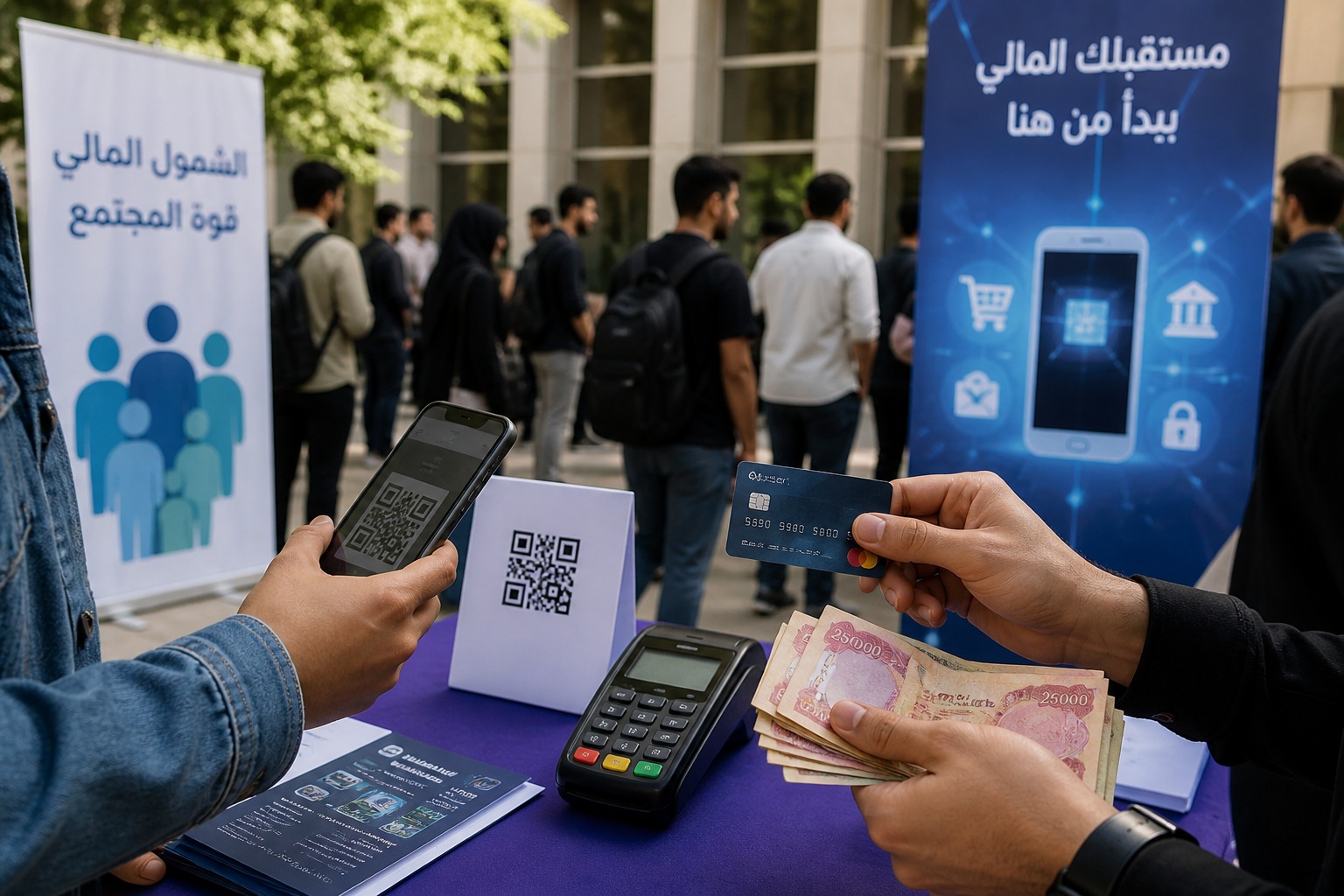
As Iraq reaches the midpoint of the Arab Financial Inclusion Week, attention is shifting from announcements and launches to evaluating what has actually been achieved on the ground. After several days of field activities and awareness programs, the key question is no longer “What will happen?” but rather: “What has truly changed?”
These initiatives come within a broader direction led by the Central Bank of Iraq to promote financial inclusion, reduce reliance on cash, and encourage wider adoption of digital financial tools.
Strong Field Presence… and a Direct Message
Since the start of the week, there has been a clear shift toward on-the-ground engagement rather than limiting activities to conferences. Universities and public institutions have hosted direct interactions with the public, including:
● Awareness sessions داخل الحرم الجامعي (on campus)
● Introductions to modern banking services
● Practical demonstrations on how to open accounts and use cards
● Explanations of how digital wallets fit into daily life
This direct engagement reflects a growing understanding that financial inclusion cannot be achieved through messaging alone—it requires reaching users within their everyday environments.
Focus on Youth: A Long-Term Investment
One of the most notable features this year is the strong focus on youth and students. This is not random—it reflects a deeper understanding of financial transformation dynamics.
Young people are:
● More comfortable using applications
● More open to digital payments
● Less attached to traditional cash usage
Targeting this group represents a long-term investment in shaping a new financial behavior that could differ significantly from previous generations.
Financial Inclusion Today: From Access to Usage
Financial inclusion is no longer just about opening bank accounts—it is now about:
● Using cards instead of cash
● Paying through POS systems
● Relying on financial applications
● Managing money digitally
This shift shows that financial inclusion is evolving from a theoretical goal into a financial lifestyle.
What Has Actually Been Achieved So Far?
Despite visible activity, a realistic assessment suggests that achievements at the midpoint can be summarized in three main areas:
1. Increased Awareness
There is noticeable improvement in user understanding of concepts such as:
● Bank accounts
● Payment cards
● Digital wallets
However, this awareness is still in its early stages.
2. Strong Engagement in Educational Environments
University-based activities have seen good attendance and engagement, especially when content is simplified and aligned with student needs.
3. A Persistent Gap Between Knowledge and Action
This is the most critical point.
Despite access to information and services, many users still:
● Prefer withdrawing cash
● Hesitate to use digital payments
● Do not rely on apps for daily transactions
The Real Challenge: Changing Behavior, Not Just Spreading Information
The experience so far confirms that the challenge is no longer about raising awareness, but about:
Turning awareness into daily behavior
This requires more than awareness campaigns, including:
● Improving user experience
● Building trust in services
● Ensuring system reliability
● Expanding payment acceptance points
● Providing real incentives for usage
Iraq in a Sensitive Transitional Phase
The current landscape shows that Iraq remains in a transitional phase between:
● A traditional cash-based economy
● A growing digital financial system
This phase requires continuity, as financial behavior does not change within a week—it evolves through cumulative initiatives and real-world experiences.
Conclusion
At the midpoint of Arab Financial Inclusion Week, it is clear that:
field engagement has been achieved, awareness is forming—but real transformation is not yet complete.
Success is not measured by the number of events or attendees, but by how user behavior changes afterward.
The key question remains:
Will these initiatives translate into sustained, real usage…
or remain just the first step in a long journey toward a truly digital economy?