
Digital Bank or E-Wallet? Many Iraqis Still Confuse the Two
Not long ago, I was discussing digital financial services with a friend When I mentioned that Iraq could eventually see the emergence of more digital banks, he smiled and replied, What's the difference? We've had electronic wallets for years
That single sentence reflects a common misconception among many users in Iraq Simply having a mobile application that allows people to send and receive money leads many to believe that an electronic wallet is the same as a digital bank
In reality, however, the difference is significant—not in appearance, but in the role each one plays
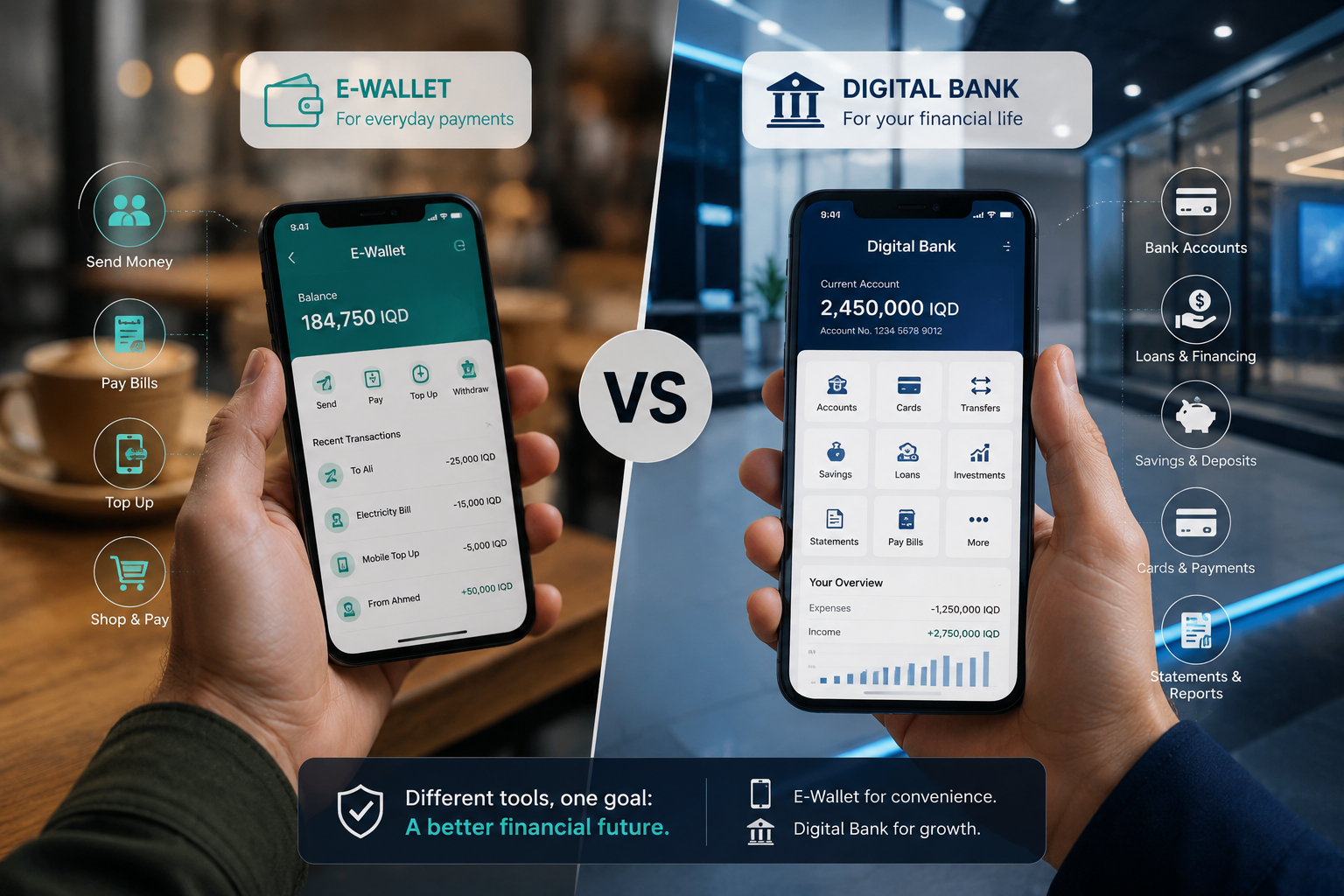
If you open your e-wallet application today, you will likely be able to transfer money to a friend, pay bills, purchase mobile credit, or pay at merchants that accept digital payments From the user's perspective, these are valuable and convenient services, making it easy to feel that nothing more is needed
But imagine that next year you want to buy a house, obtain financing for a small business, open a savings account for your children, or request an official bank statement for a government agency or employer
That is when you discover that an electronic wallet was never designed to provide these types of financial services
An e-wallet is built to facilitate the movement of money
A bank is designed to manage your entire financial life
The distinction may seem subtle, but it is fundamental
An electronic wallet is much like the wallet you carry in your pocket You store money in it, make payments, receive funds, and use it for everyday spending
A digital bank, on the other hand, is essentially a full-service bank branch inside your smartphone Through it, you can open an account, manage your savings, request debit or credit cards, apply for financing, monitor your financial obligations, and potentially access investment services—all without stepping inside a physical branch
This is precisely why an electronic wallet cannot be considered a complete replacement for a bank, just as a digital bank cannot eliminate the need for electronic wallets Each serves a different purpose within the financial ecosystem
In Iraq, electronic wallets have achieved remarkable growth over the past few years, becoming part of the daily lives of millions of citizens, particularly following salary localization initiatives and the expansion of electronic payment services
However, this success does not mean that Iraq already has digital banks in the true sense of the term
A digital bank requires a banking license, regulatory supervision, sufficient capital, risk management systems, compliance with anti-money laundering regulations, and the ability to offer a comprehensive range of banking products and services
Electronic wallets operate under a different framework, one primarily focused on payments and money transfers
This is why, in many countries around the world, digital banks and electronic wallets coexist rather than compete They complement one another instead of serving as substitutes
Some may ask:
If electronic wallets are already successful, why do we need digital banks?
The answer is simple
As users' financial needs become more sophisticated, payments and transfers alone are no longer enough People eventually need savings products, financing solutions, wealth management tools, and broader banking services—and this is where digital banks become increasingly important
Likewise, if Iraq introduces fully digital banks in the future, it does not mean electronic wallets will disappear They will continue to serve as the fastest and most convenient solution for everyday payments and small-value transactions, just as they do in many international markets
Perhaps the real challenge in Iraq is not the absence of digital banks, but the widespread assumption that every financial application is a bank, or that every electronic wallet is capable of delivering a complete banking experience
As Iraq's fintech sector continues to evolve, understanding the distinction between these financial tools will become increasingly important This knowledge will help users make better financial decisions and choose the services that best match their individual needs
Ultimately, the future of fintech in Iraq is not about choosing between digital banks and electronic wallets
It is about building an integrated financial ecosystem where both work together to provide users with a seamless, secure, and comprehensive financial experience—without forcing them to compromise on the services they need