

Are Apps Reshaping the Labor Market in Iraq?
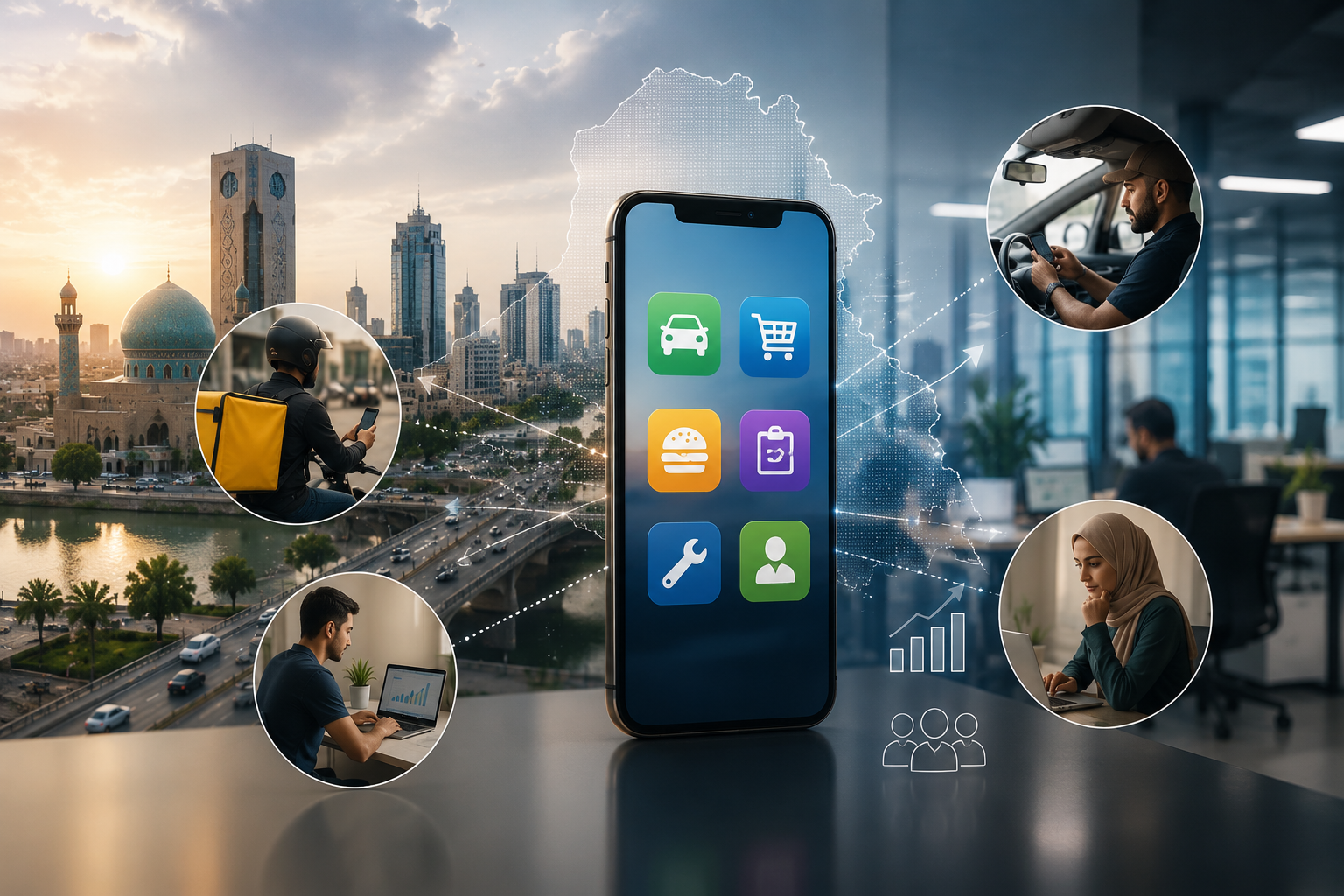
In Iraq, apps are no longer just tools for ordering food, booking rides, or transferring money. Over the past few years, they have gradually evolved into something much bigger:
A complete labor market.
Today, thousands of Iraqis wake up in the morning not to go to a government office or a traditional company, but to open an app on their phones.
A driver starts the day through a ride-hailing platform.
A young entrepreneur sells products through TikTok and Instagram.
A former employee manages social media accounts and digital campaigns.
Others rely entirely on online orders as their primary source of income.
For some, monthly earnings are now tied more closely to an algorithm than to a manager or a workplace.
This raises an important question:
Are apps beginning to reshape the very concept of work in Iraq?
Traditional Employment Is No Longer the Only Dream
For decades, the traditional image of career success in Iraq was straightforward:
- A government job
- Or a stable private-sector position
- A fixed salary
- Predictable working hours
- Long-term job security
Today, however, the picture is changing.
A growing number of young Iraqis see their smartphones as a new workplace.
Many generate income through:
- Delivery services
- E-commerce
- Digital marketing
- Content creation
- Live streaming
- Social media management
- Digital brokerage
- Reselling products through online platforms
In some cases, app-based work provides income faster than jobs that require years of education or long waiting periods.
Quietly, the social equation is beginning to shift.
Iraq Has Entered the App Economy
What is happening today is not merely a temporary trend.
Iraq is gradually entering what can be described as:
The App Economy.
An economy driven by:
- Platforms
- Algorithms
- On-demand services
- Ratings and reviews
- Flexible work models
Rather than relying solely on traditional employment structures.
What is particularly interesting is that this transformation is happening rapidly, while many institutions and even parts of society still view it as secondary or temporary.
The reality, however, is that thousands of Iraqi families now depend directly or indirectly on this digital economy.
Apps Have Created Opportunities—But Also Vulnerabilities
The challenge is that this rapid growth has not been accompanied by systems capable of protecting workers within this new economy.
A delivery driver may work:
- Long hours
- Without social security
- Without insurance coverage
- Without clear financial stability
- And without knowing whether the platform will change its policies tomorrow
Likewise, a social commerce seller may lose an entire source of income due to:
- Account suspension
- Algorithm changes
- Reduced visibility
- Or even a simple technical issue
This highlights one of the biggest risks of the app economy.
People are increasingly building their financial lives on platforms they do not truly control.
Algorithms Have Become the New Managers
In many cases, apps now have greater influence over workers than traditional employers.
A platform rating can determine:
- Income levels
- Number of orders received
- Visibility opportunities
- Even continued access to work
This has created a new form of indirect digital control.
Workers are no longer managed solely by supervisors or companies—they are increasingly managed by algorithms they often do not fully understand.
In many situations, users do not even know why their earnings declined or why demand suddenly dropped.
The Market Is Moving Faster Than Regulation
Iraq is experiencing a genuine digital economic transformation, yet legal and regulatory frameworks remain behind the pace of change.
There is still limited discussion about:
- Workers' rights within digital platforms
- Financial stability
- Taxation
- Legal protection
- Insurance coverage
- The long-term future of platform-based work
The market appears to be moving ahead on its own while regulators struggle to keep up.
Social Culture Is Changing Too
A few years ago, working through the internet or apps was often viewed as temporary or not entirely serious.
Today, the situation is different.
It is now common to find:
- A young man relying entirely on a delivery platform
- A woman running an online store through Instagram
- Someone selling products via TikTok
- Or an entire family supported by e-commerce activities
This means apps are no longer influencing only the economy.
They are beginning to reshape society itself.
Apps Are Changing More Than Jobs
Perhaps the most significant transformation is not the jobs themselves, but how people think about work.
An entire generation is beginning to believe that:
- Work does not necessarily require an office
- Income does not necessarily require a traditional employer
- And a smartphone can sometimes be more valuable than a formal workplace
This shift could fundamentally reshape Iraq's labor market in the years ahead.
Conclusion
Iraq is not merely experiencing digital expansion or a surge in mobile applications.
What is happening runs much deeper.
The country is gradually entering a new phase where:
- The app becomes the workplace
- The smartphone becomes a source of income
- And algorithms become part of everyday economic life
The most important question is not:
Will the app economy continue to grow?
But rather: